
Turning Data into Advantage: A Conversation with Lina Mikolajczyk, Chief Data & AI Officer at Venatus
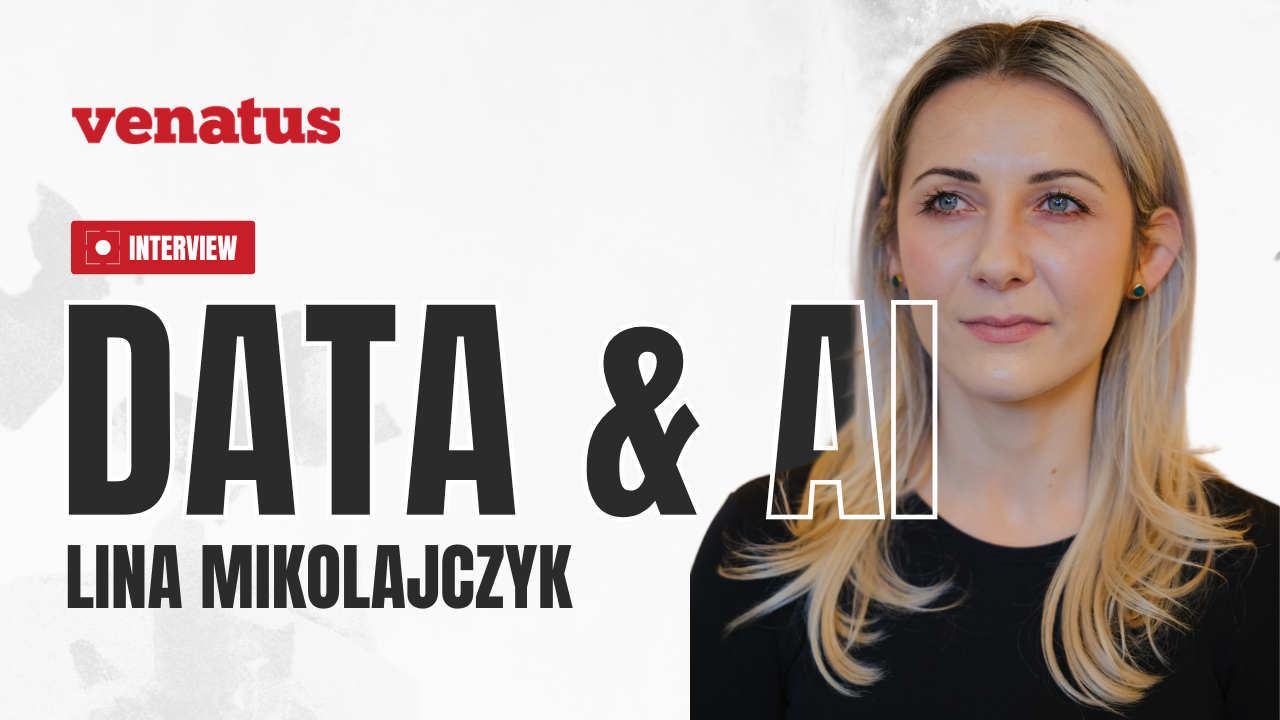
Lina Mikolajczyk recently stepped into the role of Chief Data & AI Officer at Venatus. In this interview, she shares her perspective on the current state of AI in AdTech, the importance of governed decision loops, and why trust in data is the foundation of any strong publisher partnership.
No items found.
April 2026
Introducing Lina
"I’m really excited to be here. It’s my second, going on third, month at Venatus, and I’ve learned more about AdTech in that time than almost any other subject in my career.
I’ve worked in data for a long time, but always at the intersection of data and business value. Some data roles focus purely on reporting or engineering. My focus has consistently been how we take the data a business is sitting on and turn it into measurable value.
Before Venatus, I led the data team at Bumble. The core question there was simple: we have all this data. How do we use it to drive meaningful business outcomes? I’ve also worked across industries at Hilton, moo.com and Dojo, moving deliberately between sectors to prove that strong data thinking can unlock value anywhere.
That’s why I’m excited about Venatus. We sit on an enormous amount of data, including publisher data, auction-level data, campaign performance data, audience insights and traffic trends. My goal is to bring it together in a way that drives the business forward."
The Current State of AI in Business and AdTech
"AI is at a pivotal moment for many businesses.
Some companies are already highly mature. They’ve productionised AI, implemented agents, built automated workflows with human oversight and embedded it into how they operate.
Others are still cautious and hesitant to use tools like ChatGPT for basic tasks. There’s a wide maturity spectrum across the industry.
This feels similar to the early “big data” era, when everyone was trying to move up the maturity curve. Now, businesses are doing the same with AI and asking what the next level looks like.
In AdTech, it’s particularly interesting. Publishers are concerned about how AI will impact traffic, competitiveness and monetisation. On the media side, there’s excitement about automation, workflow improvements and using AI to drive better performance and creative outcomes.
There’s huge curiosity and hunger, but not everyone is moving at the same pace."
How Venatus Is Approaching AI
"Over the past few months, my role has been to assess honestly where we are and where the opportunities lie. There are opportunities everywhere.
However, our goal isn’t to be AI-first for the sake of it. Simply throwing AI at a problem doesn’t solve it. Context matters. You have to define the problem first.
My focus has been identifying the real problems we need to solve and then determining whether AI is the right solution.
In practice, that means scaling areas that are repetitive, prone to human error or operationally burdensome. It also means identifying where a more customised approach could drive higher yield for publishers.
The key is building feedback loops. If we automate or introduce an AI-driven solution, we need to ensure teams are working alongside it and feel secure in the outcomes. This is not about releasing AI and seeing what happens. It’s a controlled and governed approach."
Why Governed Decision Loops Matter
"The winners in ad monetisation won’t be the teams that simply use AI. They will be the teams that build governed decision loops.
A practical example is experimentation within auction dynamics.
You might run an experiment and see a 5 percent uplift. That’s compelling. But the job doesn’t end there. You need to monitor how that uplift translates into revenue and publisher performance over time.
Too often, a feature shows early promise, gets rolled out network-wide and is then forgotten. That’s not sustainable.
Performance changes depending on context. A configuration might work extremely well during high-traffic periods but underperform during lower traffic. If you’re continuously monitoring, you can adjust by turning features off when needed and ramping them up during key commercial moments.
Product development doesn’t end at deployment. Different features and models serve different publishers and different market conditions at different times. Governed loops mean constantly checking whether the approach is still the right one."
The Gap Between Data Collected and Data Used
"There is a clear gap between the data publishers collect and the data they effectively use.
For years, the mindset was to collect everything. The more important question is how much of that data is actually used day to day.
Exploring underutilised data requires time and intention. Most teams focus on what’s needed immediately. There’s rarely space built into product or engineering cycles for exploration and innovation.
One way to address this is to deliberately allocate time in sprint cycles for exploration.
AI helps here. Analysts can produce dashboards and reports much faster, which frees up time to go further. They can explore patterns, identify unexpected trends and provide additional context beyond the initial question.
That additional layer of insight can often lead to far greater business impact than simply answering the original request."
Why Forecasting Is a Force Multiplier
"Forecasting plays a crucial role in monetisation.
For publishers evaluating monetisation partners, confidence in projected yield is fundamental. They want to understand what revenues they can expect before signing on.
Beyond onboarding, forecasting provides control. If you understand seasonal or cyclical traffic patterns, you can plan around downturns and test new initiatives more confidently.
For example, a publisher with traffic spikes around gaming releases needs to understand those cycles. Accurate forecasting allows them to prepare for slower periods and explore new strategies proactively.
On the sales side, advertisers and agencies want confidence that their spend will deliver expected results. The more secure you are in your forecasts, the further ahead you can plan budgets, creative and formats. Weak forecasting leads to reactive decision-making. Strong forecasting enables strategic thinking."
Rigorous Optimisation vs AI Theatre
"There are natural phases companies go through with AI.
The first phase is often unstructured adoption, where everyone is given access to AI tools without guardrails. This can lead to unvalidated dashboards, unchecked outputs and low-quality code generated without oversight.
The second phase introduces guardrails. Expectations are defined by department, metrics such as errors or rollbacks are tracked and there is clarity around when AI is being used.
In engineering, for example, you might define checkpoints where humans must review AI-generated code and track override rates or error rates.
The third phase is more mature. With context, guardrails and trust established, teams can use AI more confidently and creatively.
The difference between rigorous optimisation and AI theatre is governance. Without structure and validation, AI outputs can be misleading. With governance, AI becomes a reliable accelerant."
Transparency and Trust with Partners
"Transparency is essential.
If we’re experimenting with AI, and we should be, we have a duty to disclose what we’re doing, what outcomes we’re aiming for and how performance is being measured.
Innovation without transparency erodes trust.
One initiative we’re launching is a publisher beta programme that gives publishers access to experimental features, including AI-driven ones. They can opt in, see outcomes directly and evaluate yield impact in a controlled way.
That’s how trust is built: by being innovative and transparent at the same time."
The Most Important Data Capability in a Monetisation Partner
"At the foundation, trust in the data itself matters most.
Publishers should look for transparency in definitions, calculations and methodology. If reporting feels like a black box, if numbers are inconsistent or lack context, that’s a red flag.
A strong monetisation partner provides coherent, well-defined data that enables publishers understand their business clearly. Alignment of incentives and clarity of methodology signal a healthy partnership.
If you can trust the data, everything else becomes possible."
--


.png)

Proud members of


Copyright © 2026 Venatus Media Limited


